Tuesday, July 3, 2012

Labels: The Good, the Bad, and the Ugly

I often complain about how unnecessary it is that we feel the need to label everything, especially our relationships. Often when two people start seeing each other, they will eventually reach a point where deem it necessary to DTR (define the relationship), which amounts to putting a label on it. The label serves two main purposes: it helps the couple understand what they are, and it lets outsiders know how to cognitively categorize them. The problem with these labels is that we have a tendency to not ascertain that the agreed upon label shares the same qualities to each person. If I ask a girl, "So are we friends or dating?" and she responds, "We're dating." - I could take that to mean we are going on dates, while she means we are in a romantic relationship. There is a world of difference between these two conceptions of "dating", and yet we throw the word around and expect people to immediately understand which version (I'm sure there are even more) that we're talking about.

It is worth asking what the purpose of these labels is at a broader level. Labels serve their purpose by taking a continuous variable and making it discrete by restricting the range on that variable. Think about how age works. Is there a difference in a person who is 20 years and 364 days old, and someone who is 21 years old? Not really. But we have to draw the line somewhere in order to get coherent categories. Without categories, we'd be lost on many subjects. Similarly, this distinction of labeling is how we take a piece like this and draw an arbitrary line where blue ends and green begins:


But you could also argue that there is a third color in there between them. Or maybe there are five colors. If you looked at any individual pixel, it would look indistinguishable from its neighbor, yet we can see the gradient changing colors. This is both the purpose and problem with labels. When you want to paint your house teal and the only listed options are green or blue, what do you do? Imagine that everyone can see the middle of the gradient, but there was no name for teal - and teal was what you wanted. So clearly this act of labeling becomes problematic sometimes. What about in relationships? What is it that defines the label we get it? I'm going to propose how things are currently (for most people), and then how I think they should be

People get their own idea of what constitutes a relationship from their experience. You witness your family, friends, and fictional characters entering and leaving various relationships throughout your whole life. In the same way that we learn the meaning of most words without ever being told directly, we form a schema of a relationship. A schema is a set of characteristics that defines something. It is similar to the word concept, except that each schema is filled with other schemas which link to other schemas. If that sounds confusing, maybe this confusing picture will help:


Imagine that the word "relationship" is in the middle. Each person is going to have a different set of other schemas branching out, which means that each person's idea of what a relationship is, is going to be fundamentally different. Now, a relationship is a trickier and broader concept than an egg. So when two people decide to be "in a relationship", they're bringing different schemas to the table. The problem is, rarely do people ever define the word "relationship" when they define the relationship

What is desired from the labeling is a concreteness that is otherwise fleeting. When discussing abstract concepts such as thoughts and feelings, there is no object in the world that we can point to and say, "This! This is what I mean!" in the same way that we do for physical objects. Because we cannot do this, we are left hoping that we use these words in the same way when we frequently do not.
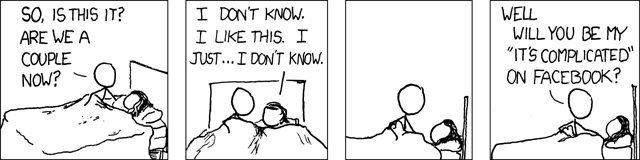

What I instead propose is that relationship categories should be defined based on their qualities, not the qualities based on the relationship category. To make the example simple, imagine that there were five qualities relationships could have:
  1. General interest [y] or [n]
  2. Physical intimacy [y] or [n]
  3. Priority over other individuals [y] or [n]
  4. Exclusivity [y] or [n]
  5. Living together [y] or [n]
If you just have (1), then it sounds like friendship. If you have (1) and (2), you probably have some form of a friends with benefits. If you have (1), (2), and (3), then it sounds something like a polyamorous "main" or an open relationship. If you have (1), (2), (3), and (4) that sounds like a traditional committed, monogamous, romantic relationship (CMRR). If you have all 5, then that sounds like a possible engagement or marriage, or it could just be a CMRR living together. The point of this all is that relationships are built on qualities, qualities that far outnumber the ones I've listed here. I didn't even include the other possible, non-sequential combinations such as (1) and (3), maybe we'd call that best friends.

The issue is that the number of categorical labels we have is finite in practice, whereas the the number of possibilities is infinite in principle. The labels we have just don't cut it, and they're not informative. This is partly why I eschew them altogether when it comes to my relationships. Everyone is a "friend" although I do varying things with each of my friends. But no one else feels the need to get different labels for "the friend I go shopping with" and "the friend I play video games with" - they all collapse into friend, which we generally understand. It's when sex gets involved that we want all sorts of labels - and it's where I disagree that sex is important enough to warrant the change.


Friday, June 29, 2012

Fifty Shades of "Everyone is doing it"

You may or may not have heard of a little book called Fifty Shades of Grey. It's been on top of Amazon's best seller list for three months now. The success of the novel is an interesting story. It is by no means the first erotic fiction to be written; thousands of erotic/romance novels are published every year. This book got popular the way many books do - good luck on word of mouth circuit. But here is the interesting thing about the word of mouth with this book: the word of mouth is not entirely positive. Tons of readers (myself included) have picked up a copy of this book because we're heard that this erotic tale gives its audience the wrong impression of what a BDSM relationship is like. But I know that I am in no place to criticize the content until I've read it. Likewise, I know others who have heard it's just a ridiculous, trashy novel - they just want to read it because everyone is reading it. They want to be part of the conversation.

What many people don't know is that Fifty Shades of Grey started out as Twilight fan fiction. That doesn't make it inherently bad, but it is done explain a bit of the character development. And now, E. L. James has managed to take her Twilight fan fiction and turn it into something amazing - a book that people want to read even if they think it's pure crap. And that, is kind of amazing.

Tuesday, June 26, 2012

Evolution and Sexual Selection, Or: Why Men and Women be Actin' Different In Da Club

Paramount to understanding much of human interaction is the theory of evolution, specifically how it relates to sexual selection. This is important because most of what we do (in many domains, not just sex) is not based on well-thought out reasons that we completely understand. In fact, most reasons amount to circular arguments or tautologies (ie: "Because I just want to!") that tell us nothing about what's really going on.


So when your average guy says, "Man, look at the tits on that girl!" - he is indicating his attraction. What he doesn't know is why he should be attracted to protruding mounds of fat on her chest, when the same amount on her stomach would generally indicate disinterest. If you asked Mr. Average Guy, he could not tell you. He might be able to bullshit, but he won't give you a real reason. Here's what's really going on in his head: "Man, the size of that girl's bossom in ratio to her waist indicates that she is healthy and fertile, ready for childbearing, and I wish to procreate with her in order to produce offspring with a high chance of survival so that my genetic components may be passed on."

But he doesn't know that.


Similarly, when a guy wants to bang every girl in the club, it's because it was an adaptive strategy in the environment our brains evolved - around 200,000 years ago. No, there were not clubs 200,000 years ago. But there were plains with plenty of fertile females. Since our genes want to make more copies of themselves, they built bodies that could do this with sexual reproduction. They also built bodies that would enjoy sex so we want to do it. They also built bodies that just wanted to basically fuck all the time so these genes would get like, really spread.

But how come females are generally more selective? I know there are some girls who are down to bang everything (no hate) and guys who are super picky, but I am talking in generalizations here - bear with me. They are selective because of something known as sexual selection. This is because in a world before birth control, if you banged a girl, chances are she was gonna be having a baby. But the investment for making a child is anything but congruent. If there are unlimited, willing females, a male can fuck them all and make many, many children. For any given woman though, there is a 9-month investment, on top of having to raise the child to maturity so it doesn't drown in it's own vomit or something. This is why women are typically the choosers when it comes to sex. So when they see a hot guy, they might be like, "Oh girl, that man I been talking to is fiiiiiine. I might go home with him tonightttt." - but they couldn't tell you why in any way that wouldn't be circular. Here's what's really going on in their head: "Oh girl, that man seems like he is of the right genetic composure to create suitable offspring, and his demeanor indicates that he will stick around for the raising of said offspring, so my genetic components can be passed on."


No one in their right mind thinks like that.

Doesn't mean it isn't true though.

So you want to know why that girl/guy won't bang you? Fucking evolution, man.

Monday, June 25, 2012

The Beginning

I had been thinking for awhile about starting a blog, but for one reason or another, never got around to it. Instead, I collected ideas that I wished to write about.

I have decided to finally give the blogosphere another go with my new blog "On Becoming Sentient" - I'd like to talk a little bit about what the title means.

Sentience is generally defined as the ability to have subjective, conscious, perceptual experience. It is one of (if not the) differentiating factor(s) between human beings and the machines we create. As of yet, our robots are not self-aware. Whether they ever will be is yet to be seen, although science-fiction supplies us with no shortage of thought experiments on what the outcomes might be like. 

Human beings are not robots - or are we? I will argue - in this blog - that we are robots, albeit a very different, special kind of robot. This idea was first borne to me some time ago when reading about Francis Crick's The Astonishing Hypothesis:
"You, your joys and your sorrows, your memories and your ambitions, your sense of personal identity and free will, are in fact no more than the behaviour of a vast assembly of nerve cells and their associated molecules."
We are far-less in control than we think. We did not choose our parents, our birthplace, our genes, or any of the important things that set up who we are today. Instead, we make small choices that affect us in subtle ways. Our sensitivity to these slight changes allows us to devote great amounts of time to what others might call "trivial." The similarities between any two individuals are far more numerous than the differences. This tendency to focus on what is different between ourselves and others hurts our ability to notice how similar we are.

I generalize with the pronoun we because is it something we are all guilty of. But it is important to note that this method of thought is not our fault. It is rather the natural state of things, that can be only be escaped through patience and persistence. This form of escape is what I refer to as becoming sentient.

To become sentient is to acknowledge that the illusion of free will is just that - an illusion. It is to understand that the drives you feel (produced by millions of years of evolution) are no more in your control than the next sentence I type. It is to understand that you are just as insignificant as I am; as any individual is to anyone else in the grand scheme of the cosmos. It is to acknowledge a lack of rules or meaning set out from on-high. It is to understand all this and not feel sad, broken, or terrified. It is to understand insignificance and revel in it. It is to create meaning where the universe has given none.

This process is not easy, and I do not expect anyone to read the above paragraphs and immediately agree with me. In fact, I would be skeptical if anyone took all my claims at face value and felt none worth challenging. This introduction is not meant to convince, but to give the reader an idea of the content to come.

Not every post will relate to this thesis specifically; it should be thought of as a uniting theme running underneath every word. That is to say, the ideas I plan to present will make the most sense in the light of this framework.

Thank you for reading the first of many posts to come.