Showing posts with label relationships. Show all posts

Wednesday, November 21, 2012

Most Rapists Don't Know They're Rapists

The idea for this post came from a conversation I had after I posted this link on Facebook yesterday. I was then met with some comments that surprised me, such as:
"Those who rape know damn well that no means no. That's what makes it worthwhile for them. They're not confused by the idea that some women are supposed to play hard to get."
and
"Rapists are sensitive to labeling themselves as such. However, they invariably know, and enjoy, the fact that they're forcing the woman."
and
"The typical rapist attacks serially and is only stopped with a jail sentence, but yes, the 1st time he has non-consensual sex makes him a rapist, and not just "technically."
and
"I've heard from a couple of different sources that rapists are like hunters stalking for their next victim. I heard a statistic that although about 7% of men have attempted or committed rape, the number of women raped is much higher because these men have more than one victim. This statistic comes from a study of young men that ask about some of their behaviors, like, do you get excited/hopeful/aroused when a woman gets sloppy drunk. The study does not use the word rape because, as you point out, even the East Coast Rapist can't call himself that. However, the 7% of the men's answers point to raping behaviors."

To which, I had to respond:

I'm going to try and find some empirical sources, but until then I'll supplement with my own anecdotal evidence. I have a number of friends that have been raped. I also know quite a few people that work for the Sexual Assault Response Prevention Program (SARPP) at my school.

Recently, my school participated in The Clothesline Project which involved survivors of sexual assault writing on t-shirts and hanging them up for all to see. By the end of the day there were hundreds. Some of them were talking about how they didn't let the assault break them, some were talking about how they can't trust men anymore. But most of them involved calling attention to their attacker, either by name, fraternity, or some other means. Almost all of them mentioned that this guy was a friend. I couldn't even count the number of times I saw written "my rapist doesn't know he's a rapist." Because rapes are underreported

Why? Because most of the time, they cannot be proven. And people do not want to believe that the quarterback, the valedictorian, or the shy kid could take advantage of a girl. But they do. These men are not predators in the sense that they consciously hold a hatred of women, get off on hurting people, or sit waiting for their next victim. No, these are merely men to whom the notion of consent doesn't matter

Part of this is because our culture has inculcated the idea of "playing hard to get" as the article mentions. Regardless of whether or not women do this, most men have the idea that women do. And this means that when they are met with resistance, they just push harder. It is very different from "I am planning on raping someone tonight because that's what turns me on." Those types are rare. It is rather, "But if she didn't want to have sex then why was she making out with me? She totally wanted it, I just helped convince her."

This is misogynistic thinking fueled by the simple idea that women are there for us to consume and use; that they are not autonomous beings who have their own beliefs, desires, and fears. And in that moment, they believe that you're not going to stop, they're afraid that they're right, and they desire to get out. There isn't the black and white line between "rapists" and "everyone else" that most people think there is. To claim that is to be part of the problem; to be a rape denier. To deny the fact that hundreds and thousands of women are assaulted every year by their acquaintances, friends, and even partners. To claim that "rapists" are merely psychopaths as opposed to regular males who merely don't understand consent and happen to be in a situation to exercise their power is blind yourself to the majority of sexual assaults.

Thursday, August 2, 2012

Slut Shaming and Why It Needs To Stop

What is slut shaming? It is a very simple and subtle thing that many of us do without even being aware of it. It is the process of making women (and men) feel bad about their sexual choices. Often it's the word "slut" or its many synonyms used in conjuncture with a derogatory comment or tone. As in,

"Look at what that girl is wearing, what a slut."

When that is said, several implicit assumptions are made:
1) Girls who wear more "revealing" outfits are "sluts"
2) Being a slut is a bad thing

So let's get a working definition of slut then, since it would be impossible to call it a bad thing if we don't even know what one is!

The simplest definition I can seem to find is someone who has an open sociosexual orientation. This means that they are open to the idea of having sex without being in a committed, monogamous, romantic relationship. Now, most people seem to agree on this definition. But here's the problem: most of us then, by definition, are sluts. What?! How can this be? Sluts are a terrible awful no-good very bad thing... right?

The word "slut" is pejorative, meaning that it can have positive or negative connotations depending on the group that it is used in. A good way to think about this is to talk about America's other favorite set of pejorative words.

In the middle school years, kids are prone to use words like "gay" to talk about things that they don't like. They might say, "this class is so gay," or "I hate this band, they're so gay," when neither the class nor the band contain any homosexuals nor homosexual behavior. Are these kids confused about the meaning of the word? No. If you ask them, they get it right. But when asked why they use the word like that, they'll probably shrug. Everyone knows that when they say something is gay it doesn't mean actually gay. Right. But if the connotation is that "gay" is a synonym for "things that are bad," suddenly this doesn't seem okay anymore. Most progressive teens start getting aware of this around high school and stop calling things gay. They even might call out others that use it, stating that use of the word in that pejorative sense is homophobic. What predicts this kind of pro-LGBT behavior? Knowing someone who is gay. That is why gay rights campaigns urge people to come out of the closet if they can. The single biggest aid to fighting homophobia has been the realization that, hey, lots of people are gay, and they're just people like the rest of us.

What does this have to do with slut shaming? Well, because when it comes to the word "slut," we're still in middle school. We know what it means, but we use it talk about people we don't like, almost exclusively women. In fact, when men are called sluts, it's usually in the form of the euphemistic "man whore." It is far more acceptable for men to be sexually promiscuous and open about their exploits than it is for women. So instead, we have lots of women who are sexually free in this sense, but they feel bad about their own behavior. They feel bad because we have taught them to feel bad. They slut shame themselves. This is because they're in the slut closet and don't want to come out into a world that disdains what they do. But where does this slut shaming come from?

There are evolutionary reasons why men and women have different sexual preferences and strategies. It our ancestral past, it was an adaptive strategy for women to be very choosy with whom they mated with. This was because they would bear the burden of carrying a child to term, being unable to mate in the interim, and then raising said child. So it made sense that women would care more: their investment was higher. Men invested a few minutes of work, and that was all they needed to pass their genes on.

The truth is that these behaviors are rooted in human nature, but reinforced by our society. Because we subvert human nature all the time. Why do we like to eat, often to the point of it being unhealthy? Because it was adaptive in our past to eat as much as we could because food was scare. Now we have obesity, an unintended side effect of this drive. Likewise, most of the sex in we have as a species in this contemporary age is not for procreation. But that's what sex is biologically for. It feels good because those who enjoyed it had more offspring, so we have a species that loves to fuck, and that most of the time is not thinking about having children.

Today we have a set of men and women who seem to police women who might not be as choosy about their sex partners. If you asked them why, they probably couldn't tell you. Evolutionary theory gives us some clues, but its not the entire story. The fact is that when people engage in slut shaming, they are not thinking, "Look at that silly girl! By not being more choosy about her sexual partners and waiting to invest in a man who will also invest in her, she is liable to make a mistake and possibly end up with a poor genetic recombination with a man who will not aid in raising the child!"

There are many dark, undesirable sides of human nature. The fact that it may have been adaptive to be misogynistic, xenophobic, and violent in our past does not mean that because they have some "natural" origin, that they get a free moral pass. We are able to evaluate behaviors in a way that we couldn't then. We are not bound by the chains of human nature; our society allows us to move past it, most people just never consider it.

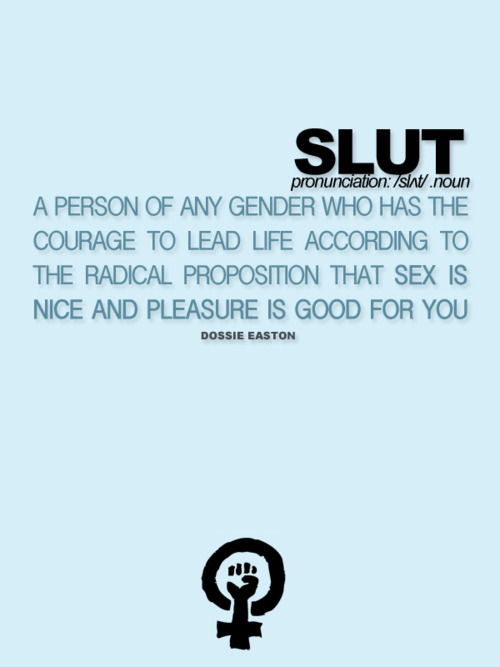
The idea of taking the word back is appealing to some people. This is what happened with the gay community. Nowadays, you might hear someone describe their friend as "gay", and it will mean just that: that their friend prefers to engage in sex with people of the same gender. So could we do the same with slut? Could slut just mean someone that enjoys sex and doesn't need the restrictions of a traditional relationship to engage in it?

I want to now ask what I feel is the most important question of all: what, if anything, is wrong with being a slut?

I think the people over www.slutsunite.org get it right.

Most people would agree with what is written there. And then suddenly, given that, what's wrong with being a slut?

It's your sex life. As long as you are being safe, sane, consensual, then do what you want. Life is too short to feel bad about doing what feels good.

Tuesday, July 3, 2012

Labels: The Good, the Bad, and the Ugly

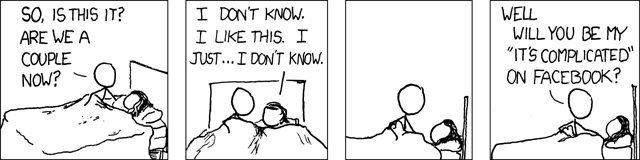
I often complain about how unnecessary it is that we feel the need to label everything, especially our relationships. Often when two people start seeing each other, they will eventually reach a point where deem it necessary to DTR (define the relationship), which amounts to putting a label on it. The label serves two main purposes: it helps the couple understand what they are, and it lets outsiders know how to cognitively categorize them. The problem with these labels is that we have a tendency to not ascertain that the agreed upon label shares the same qualities to each person. If I ask a girl, "So are we friends or dating?" and she responds, "We're dating." - I could take that to mean we are going on dates, while she means we are in a romantic relationship. There is a world of difference between these two conceptions of "dating", and yet we throw the word around and expect people to immediately understand which version (I'm sure there are even more) that we're talking about.

It is worth asking what the purpose of these labels is at a broader level. Labels serve their purpose by taking a continuous variable and making it discrete by restricting the range on that variable. Think about how age works. Is there a difference in a person who is 20 years and 364 days old, and someone who is 21 years old? Not really. But we have to draw the line somewhere in order to get coherent categories. Without categories, we'd be lost on many subjects. Similarly, this distinction of labeling is how we take a piece like this and draw an arbitrary line where blue ends and green begins:


But you could also argue that there is a third color in there between them. Or maybe there are five colors. If you looked at any individual pixel, it would look indistinguishable from its neighbor, yet we can see the gradient changing colors. This is both the purpose and problem with labels. When you want to paint your house teal and the only listed options are green or blue, what do you do? Imagine that everyone can see the middle of the gradient, but there was no name for teal - and teal was what you wanted. So clearly this act of labeling becomes problematic sometimes. What about in relationships? What is it that defines the label we get it? I'm going to propose how things are currently (for most people), and then how I think they should be

People get their own idea of what constitutes a relationship from their experience. You witness your family, friends, and fictional characters entering and leaving various relationships throughout your whole life. In the same way that we learn the meaning of most words without ever being told directly, we form a schema of a relationship. A schema is a set of characteristics that defines something. It is similar to the word concept, except that each schema is filled with other schemas which link to other schemas. If that sounds confusing, maybe this confusing picture will help:


Imagine that the word "relationship" is in the middle. Each person is going to have a different set of other schemas branching out, which means that each person's idea of what a relationship is, is going to be fundamentally different. Now, a relationship is a trickier and broader concept than an egg. So when two people decide to be "in a relationship", they're bringing different schemas to the table. The problem is, rarely do people ever define the word "relationship" when they define the relationship

What is desired from the labeling is a concreteness that is otherwise fleeting. When discussing abstract concepts such as thoughts and feelings, there is no object in the world that we can point to and say, "This! This is what I mean!" in the same way that we do for physical objects. Because we cannot do this, we are left hoping that we use these words in the same way when we frequently do not.


What I instead propose is that relationship categories should be defined based on their qualities, not the qualities based on the relationship category. To make the example simple, imagine that there were five qualities relationships could have:
  1. General interest [y] or [n]
  2. Physical intimacy [y] or [n]
  3. Priority over other individuals [y] or [n]
  4. Exclusivity [y] or [n]
  5. Living together [y] or [n]
If you just have (1), then it sounds like friendship. If you have (1) and (2), you probably have some form of a friends with benefits. If you have (1), (2), and (3), then it sounds something like a polyamorous "main" or an open relationship. If you have (1), (2), (3), and (4) that sounds like a traditional committed, monogamous, romantic relationship (CMRR). If you have all 5, then that sounds like a possible engagement or marriage, or it could just be a CMRR living together. The point of this all is that relationships are built on qualities, qualities that far outnumber the ones I've listed here. I didn't even include the other possible, non-sequential combinations such as (1) and (3), maybe we'd call that best friends.

The issue is that the number of categorical labels we have is finite in practice, whereas the the number of possibilities is infinite in principle. The labels we have just don't cut it, and they're not informative. This is partly why I eschew them altogether when it comes to my relationships. Everyone is a "friend" although I do varying things with each of my friends. But no one else feels the need to get different labels for "the friend I go shopping with" and "the friend I play video games with" - they all collapse into friend, which we generally understand. It's when sex gets involved that we want all sorts of labels - and it's where I disagree that sex is important enough to warrant the change.


Tuesday, June 26, 2012

Evolution and Sexual Selection, Or: Why Men and Women be Actin' Different In Da Club

Paramount to understanding much of human interaction is the theory of evolution, specifically how it relates to sexual selection. This is important because most of what we do (in many domains, not just sex) is not based on well-thought out reasons that we completely understand. In fact, most reasons amount to circular arguments or tautologies (ie: "Because I just want to!") that tell us nothing about what's really going on.


So when your average guy says, "Man, look at the tits on that girl!" - he is indicating his attraction. What he doesn't know is why he should be attracted to protruding mounds of fat on her chest, when the same amount on her stomach would generally indicate disinterest. If you asked Mr. Average Guy, he could not tell you. He might be able to bullshit, but he won't give you a real reason. Here's what's really going on in his head: "Man, the size of that girl's bossom in ratio to her waist indicates that she is healthy and fertile, ready for childbearing, and I wish to procreate with her in order to produce offspring with a high chance of survival so that my genetic components may be passed on."

But he doesn't know that.


Similarly, when a guy wants to bang every girl in the club, it's because it was an adaptive strategy in the environment our brains evolved - around 200,000 years ago. No, there were not clubs 200,000 years ago. But there were plains with plenty of fertile females. Since our genes want to make more copies of themselves, they built bodies that could do this with sexual reproduction. They also built bodies that would enjoy sex so we want to do it. They also built bodies that just wanted to basically fuck all the time so these genes would get like, really spread.

But how come females are generally more selective? I know there are some girls who are down to bang everything (no hate) and guys who are super picky, but I am talking in generalizations here - bear with me. They are selective because of something known as sexual selection. This is because in a world before birth control, if you banged a girl, chances are she was gonna be having a baby. But the investment for making a child is anything but congruent. If there are unlimited, willing females, a male can fuck them all and make many, many children. For any given woman though, there is a 9-month investment, on top of having to raise the child to maturity so it doesn't drown in it's own vomit or something. This is why women are typically the choosers when it comes to sex. So when they see a hot guy, they might be like, "Oh girl, that man I been talking to is fiiiiiine. I might go home with him tonightttt." - but they couldn't tell you why in any way that wouldn't be circular. Here's what's really going on in their head: "Oh girl, that man seems like he is of the right genetic composure to create suitable offspring, and his demeanor indicates that he will stick around for the raising of said offspring, so my genetic components can be passed on."


No one in their right mind thinks like that.

Doesn't mean it isn't true though.

So you want to know why that girl/guy won't bang you? Fucking evolution, man.