Showing posts with label biases. Show all posts

Wednesday, November 21, 2012

Most Rapists Don't Know They're Rapists

The idea for this post came from a conversation I had after I posted this link on Facebook yesterday. I was then met with some comments that surprised me, such as:
"Those who rape know damn well that no means no. That's what makes it worthwhile for them. They're not confused by the idea that some women are supposed to play hard to get."
and
"Rapists are sensitive to labeling themselves as such. However, they invariably know, and enjoy, the fact that they're forcing the woman."
and
"The typical rapist attacks serially and is only stopped with a jail sentence, but yes, the 1st time he has non-consensual sex makes him a rapist, and not just "technically."
and
"I've heard from a couple of different sources that rapists are like hunters stalking for their next victim. I heard a statistic that although about 7% of men have attempted or committed rape, the number of women raped is much higher because these men have more than one victim. This statistic comes from a study of young men that ask about some of their behaviors, like, do you get excited/hopeful/aroused when a woman gets sloppy drunk. The study does not use the word rape because, as you point out, even the East Coast Rapist can't call himself that. However, the 7% of the men's answers point to raping behaviors."

To which, I had to respond:

I'm going to try and find some empirical sources, but until then I'll supplement with my own anecdotal evidence. I have a number of friends that have been raped. I also know quite a few people that work for the Sexual Assault Response Prevention Program (SARPP) at my school.

Recently, my school participated in The Clothesline Project which involved survivors of sexual assault writing on t-shirts and hanging them up for all to see. By the end of the day there were hundreds. Some of them were talking about how they didn't let the assault break them, some were talking about how they can't trust men anymore. But most of them involved calling attention to their attacker, either by name, fraternity, or some other means. Almost all of them mentioned that this guy was a friend. I couldn't even count the number of times I saw written "my rapist doesn't know he's a rapist." Because rapes are underreported

Why? Because most of the time, they cannot be proven. And people do not want to believe that the quarterback, the valedictorian, or the shy kid could take advantage of a girl. But they do. These men are not predators in the sense that they consciously hold a hatred of women, get off on hurting people, or sit waiting for their next victim. No, these are merely men to whom the notion of consent doesn't matter

Part of this is because our culture has inculcated the idea of "playing hard to get" as the article mentions. Regardless of whether or not women do this, most men have the idea that women do. And this means that when they are met with resistance, they just push harder. It is very different from "I am planning on raping someone tonight because that's what turns me on." Those types are rare. It is rather, "But if she didn't want to have sex then why was she making out with me? She totally wanted it, I just helped convince her."

This is misogynistic thinking fueled by the simple idea that women are there for us to consume and use; that they are not autonomous beings who have their own beliefs, desires, and fears. And in that moment, they believe that you're not going to stop, they're afraid that they're right, and they desire to get out. There isn't the black and white line between "rapists" and "everyone else" that most people think there is. To claim that is to be part of the problem; to be a rape denier. To deny the fact that hundreds and thousands of women are assaulted every year by their acquaintances, friends, and even partners. To claim that "rapists" are merely psychopaths as opposed to regular males who merely don't understand consent and happen to be in a situation to exercise their power is blind yourself to the majority of sexual assaults.

Thursday, October 11, 2012

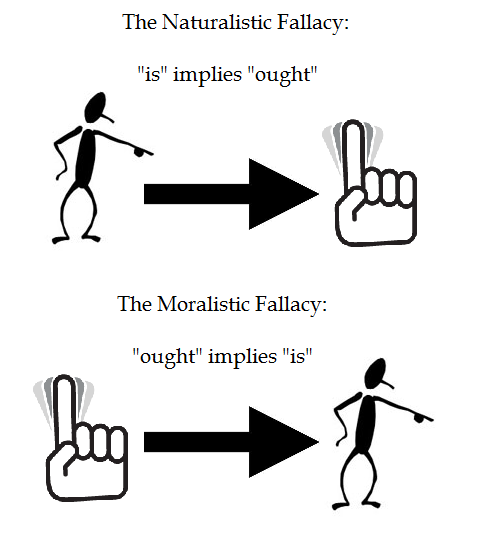
The Naturalistic Fallacy: The Way Things Are vs. The Way We Want Them To Be

The Naturalistic fallacy is committed every single time the phrase "but it's natural!" is uttered. When someone states that something is natural--assuming they're right--they have not said anything about the value we should assign to it; they have merely made an existence claim. They are trying to make a value claim based on the implicit assumption that "natural things = good." First let's unpack what it even means to say that something is "natural."

To say something is natural is to broadly say that it has not been contaminated in some way by dirty humans. It's part of the world that exists independent of our interference. The idea of natural gets tricky though when we talk about what is natural for us to do. When people say that a behavior is natural, they seem to be implying that it is a part of our human nature. This can be contrasted with normal, indicates an importance placed on the norms of rules of the society one lives in.

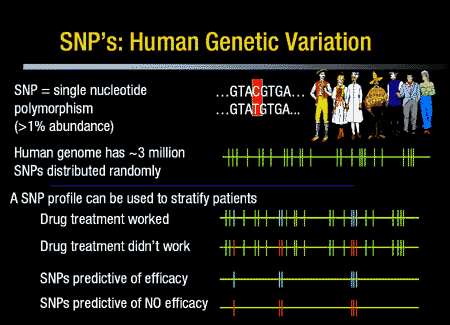
Understanding what is natural for humans is equivalent to understanding human nature. The ties that bind us into the category of humans means that we are far more similar than different. The actual difference in our genomes from person to person is 0.1%. This minute amount accounts for what we actually perceive as gigantic differences. Because we're sensitive to differences and the similarities are just things we take for granted. No one walks around going, "Oh my god, you also use language, sleep, eat food, and have a sex drive?!"

So the "age old question" of nature vs. nurture is not as mysterious as many may think. The goal of most psychological research is to find something that is similar in all of us, and for this to work, it requires the hypothesis that there is a shared human nature. If our individual differences were so extreme that nothing could ever be accurately predicted about human behavior, then psychology as a science would not exist. Through extensive research, we can determine facts about our human nature, but not all of these facts align with how we would like things to be.

Obesity is a historically recent trend. If you asked most people why this epidemic exists, their response will probably reference that people like to eat a lot, and that some people may be predisposed to having larger body types. This isn't incorrect, but it doesn't completely answer the question. We all like to eat, but why do these people eat so much? Evolutionary psychology has a satisfying answer. In our ancestral past, food was scarce so it made the most sense to eat as much of it as you could whenever possible. The taste that we developed for certain foods was based on their survival value to us. Fruits were appealing because the sugar increased glucose levels that aided in cognitive functioning. Thus, people who ate lots of fruit reproduced more leading to a higher propensity for a sweet tooth in the gene pool. Today, we can create foods that take advantage of this "sweet tooth," leading to such creations that never existed in our ancestral past. Yet even though these foods didn't exist, the cues did, and the cues are still working now, below our conscious awareness.


What this means is that if we stick to "if it is natural, it is good" then it logically follows that obesity, working on natural cues, is good. I doubt anyone would serious defend that view. They might say "The cue is natural, but the result of obesity isn't!" And I would be inclined to agree. Nature and nurture is separable in ways such as these. We have beliefs, attitudes, desires, and fears that we are predisposed to by nature (our genes), and which can be molded ever-so-slightly by nurture (societal influence). The distinction we need to make, which people often fail to do, is that there are plenty of natural things that we don't like, and plenty of natural things that we do like. Similarly, there are plenty of societal things that we don't like, and plenty of societal things that we do like. We just need to stop claiming that everything natural is automatically good because it gives a free pass to plenty of behaviors that we adaptive in our ancestral past that we can rationally say no longer aid us in the world we want to live in today.

Nothing could be less natural than birth control. It is the ultimate anti-evolution technology. If natural selection were allowed to take its course and could keep up with society (this is a thought experiment) future generations would probably possess some mechanism for subverting our birth control techniques.

The entire reason we have a sex drive is because our genes want to make more copies of themselves. That doesn't mean we have to be bound to the idea that if we want sex, we also have to have children. We don't have to in our current society. But those invoking the naturalistic fallacy would have to concede that anyone who engages in sex should want children, since that is what sex is for. The pleasure is a side effect! Individuals that enjoyed sex did it more, individuals that had more sex bore more children, individuals that had children are the only sets of genes that could have survived to the next generation. Cue 4 million years of hominid evolution working with this principle and you have our current sex-obsessed homo sapiens. It is completely natural to desire sex, even lots of sex, but that can't say anything one way or another about whether or not that's a good thing for an individual or for society. Understanding the cause of our desires is extremely important to treating the things that we want to change. If you go around telling people that their sex drive is unnatural and something that someone can control because it's been taught to them, they will not only be confused, but they will have no way of dealing with their (probably) non-existent problem. Clarification is needed. Psychology, anthropology, and biology provide the answers.

Tuesday, August 7, 2012

The Long Reach of Belief


Often I am asked, why do you care what other people believe? Well, the simple answer is that people tend to act on their beliefs. I know lots of people who don't believe in new age mysticism or God or any host of other supernatural elements, yet they just do not understand why another person's beliefs should effect me. If an individual believes that gay marriage is wrong--forbidden in the bible or otherwise--then he might actually speak out against it, protest gay rights, or use political power to rally against equality.

The issue with many of the beliefs that people hold is that they're not simple matters of taste. I may dislike Nickelback as a band, but the fact that certain people enjoy Nickelback is of no concern to me. Why? Because people liking Nickelback has no effect on my life or that of anyone else who may dislike them. Now we have established a criterion for when beliefs held by others should matter: if the beliefs cause people to act in ways that they otherwise would not.

For example, if a person is secretly racist we may find this deplorable, but if they never act on it, in what way could we know? The chances of someone actually being racist and never acting on it are probably impossible, since these beliefs manifest themselves in subtle ways that we are generally not aware of. But the point is that beliefs lead to actions. And if these actions can hurt, oppress, and generally cause harm to society, then there is warrant for us to care what other people believe.

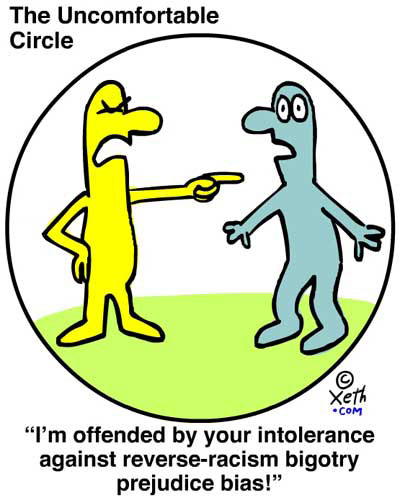
I've had people tell me that I am just as bad and intolerant of the people I am speaking out against. They've told me that just because I disagree with someone doesn't make them bad, or wrong, or give me a reason to question their beliefs. Let me illustrate a picture: does a person who is racist (something we in the liberal western world tend to think is pretty bad) have the right to say that an anti-racist is discriminating against them? That doesn't really make any sense. The people who fought to free the slaves and for civil rights aren't people we look back on and say "Geez, couldn't they just leave other people's beliefs alone?" I speak out when I think people are being oppressed or harmed.

How do we define harm? There are various ways, so I'll give some examples. When children are taught that humans walked with dinosaurs, the KKK were nice people, and gay people are as awful as rapists and child molesters, their education is harming them. When parents allow their children to die by refusing medical treatment in favor of prayer, their spiritual belief is harming them. When psychics rob people of their money by claiming they can perform spiritual healing, claim they can talk to dead loved ones, or just provide false info to further their personal gain, their credulity in charlatans is harming them. This is just a short list. I could write about a hundred more ways in which people are harmed every day due to the nature of their beliefs.

I can imagine someone saying at this point, "Okay, so some people believe some stupid things. But my beliefs don't harm anyone. For example, I don't believe in evolution and it doesn't hurt anyone."

I will attempt to illustrate that the effects of holding a view such as creationism aren't immediately obvious, but just because they aren't immediately obvious doesn't mean there can't be latent harm. For example, if there were only one person who didn't believe in evolution we wouldn't have a problem, but the fact remains that half of Americans reject evolutionary theory. And furthermore, any argument that goes, "Well, me alone doing this action isn't hurting anyone, therefore it is fine," is not justifiable when we imagine the consequences, were everyone to do it. This known as the tragedy of the commons. Therefore, yes, if you and just you alone decide to litter, you won't destroy the world, but if everyone does? Well, we're still trying to fix that mistake.

An anticipated objection at this point is "I understand that littering is bad, but you haven't demonstrated that not believing in evolution is bad."

Allow me to do so.

So we have this thing called scientific progress, where we find out more about the world and because we know more about the world we can do neat things. These include little things like medicine that makes it possible for us to live three times as long as we could a few hundred years ago (thank you biology). All the food and drink that you enjoy, all the pills you pop and the drugs you take (thank you chemistry). That little GPS in your car and in your phone that allows you to find your way (thank you physics). So what does this have to do with evolution? Two things: the first is the smaller point that the understanding of evolution allows us to create medicine such as antibiotics and helps us discover disease-causing genes. The larger point is that the denial of evolution is part of a more substantial problem: the denial of scientific curiosity. If you say to yourself, "I refuse to believe in evolution because it contradicts the bible," then you are liable to say that you refuse to believe in a great number of scientific concepts. And if you don't believe in these things, you won't have an interest in science (you might even disdain it) despite the fact that the life you enjoy today is owed to many things that wouldn't be possible without science. But hey, that's fine, no one is forcing you to become a biologist. But if we all suddenly became incurious and stopped exploring, well, we don't have to imagine what life would be like since history has done a fine job of documenting the dark ages.


Sometimes the harm of a belief is that it manages to oppress a group for no other reason than to oppress them. For example, to argue that racists are oppressed by civil rights would be quite silly. The oppressors do not get to say they are being oppressed when people speak out against them. Otherwise we would have an infinite regress of each person claiming that their rights were violated when another person disagreed with them. The buck has to stop somewhere, and it stops at the opposition. You don't get to simply oppose those who disagree with you ad infinitum; you defend your original position. So when people have beliefs such as an idea that a particular race is inferior their own, they might do something like enslave that race. Even after slavery has ended, the dominant group might continue to oppress that race. We clearly understand the link here between belief and action, and while it isn't one person who keeps the wheels of oppression turning, the mindset that "Racism is okay, even if I'm not a racist" does nothing to help those who are oppressed - it does just the opposite.

So here's how the argument breaks down: sometimes the effect of a belief is apparent, as in:
Racist beliefs --> Racist behavior 
Sometimes it's way more latent, as in:
Science denial --> Kids dying from parent's belief in spiritual healing and lack of belief in modern medicine
Sometimes the path has many stops, as in:
 Evolution denier --> Uninterested in science --> Not enough employment science/technology related fields --> No cure for cancer yet
Sometimes it's a small part of a larger problem, as in:
No issue with racist beliefs --> A system that continues to run based on oppression
In short, beliefs matter a lot.  They have an effect we are unable to see most of the time. We should not write them off as necessarily harmless for that reason alone. I consider myself a feminist, yet for so long I spent time participating in behavior quite clearly anti-feminist and lo and behold, I was completely unaware of it. It wasn't until my consciousness was raised by the efforts of other individuals that I was able to implement change.

Don't be afraid to question things. It's the only way we can get true social change.

Monday, August 6, 2012

"Stop making me think!: The Compartmentalization of Critical Thinking

I am constantly amazed how young undergraduates can spend 3 hours a week for 15 weeks in psychology learning about cognitive biases, reciting the needed information on tests, and yet fail to ever apply what they know in real life. You might think that if a person wrote a paper on confirmation bias, then they probably wouldn't proudly tweet about how their horoscope is so right, because they are such a pisces. Most of us tend to think of our lives inside and outside the classroom as separate places with very little convergence. This belief is common about a great number of things. The late Harvard evolutionary biologist Stephen Jay Gould famously wrote about a concept known as "Nonoverlapping Magisteria."It explained that the worlds of science and religion were in fact not antagonistic, but actually just pertained to completely different domains of knowledge. On this, he said:
"...we get the age of rocks, and religion retains the rock of ages; we study how the heavens go, and they determine how to go to heaven."
It's the division of two areas of reality, saying that there is more than one way of knowing. For religion, I go to my bible, for the empirical world, I go to my micro/tele/stethoscope. This compartmentalization of critical thinking happens in more places than the classroom and outside class, religion and science, but I'm going to stick with these two examples for now. I am arguing that what you learn in biology about evolution isn't just true on the test, it's true in the rest of the world. What you learn in sociology about race and class inequality isn't just a simple topic for your paper, it's based on facts about the reality that we live in. But most of us shut down these systems when we pack up and go home for the summer, the weekend, or even just tonight for this party. Nothing kills a person's buzz quite like reminding them that they're wrong, despite the fact that they learned the right answer.

This does not happen to everyone, but it happens to enough people for it to be concerning. It is the explanation for how we have wonderful scientists such as Dr. Francis Collins, the head of the NIH, who happens to be a devout Christian. He keeps his religion and science separate. He doesn't tell his colleagues not to run tests, but rather to pray. He does not attribute the success of the treatments at the NIH to God's will (at least, publicly). So why is there a problem? He is still compartmentalizing his critical thinking. He is using it in one area of his life (his work) and not applying it in others (his personal).

To get an idea what I'm talking about, think about a very simple concept that is basic to all religions: prayer. The idea that someone who does science for a living could at the same time believe in prayer is a complete division of reality within the mind of that individual. The issue with prayer is that it has zero verifiability. If it did, if it worked with the certainty you might expect from such a popular activity, then we could just fucking pray away world hunger, racism, and give each of us a million-dollar mansion to live in. Prayer seems to only give us things that could have happened in the absence of prayer. In fact, whenever we attempt to measure the effect of prayer, we have either found no effect, or (ironically) the opposite effect.

Critical thinking isn't always easy, but you actually do it more than you might know. Imagine this scenario: you attempt to turn on your TV with the remote and yet nothing happens when you press the "on" button. The first thing to pop into your head is probably not something along the lines of "god is punishing me" or "evil demons have destroyed my tv." No, you're probably (no matter how religious you are) bound to come up with a physical, natural explanation. The batteries in the remote might be dead, so you switch them from your DVD remote and see if they work. They don't, so you switch them back into the DVD remote to make sure THOSE aren't dead either. When in the DVD remote, they work fine, so it's not the batteries. You attempt to turn the TV on with the power switch on the front but nothing happens. You think the TV itself may have died, but there are other things to check first. You look behind the TV and notice that the plug had merely come out of the socket. You plug it back in and the world as you know it returns.

We have all probably done something like this before. And guess what? You were doing science! You (very quickly) created hypotheses and tested them, looking for results. Why is it easy to think critically in this situation and not others? The easy answer is that the results are instant. With the concept of prayer, you have to wait. And when you have to wait for as long as you do, such as for God to send you a husband, or for your depression to go away, or to get a promotion at your job, then you really have no way of telling if it worked. But, you may remember that you prayed about it. And when you credit prayer, you ignore the fact that you may have done hard work and earned the promotion, that serendipitous circumstance led you to your latest love, or that the medication you're taking is actually responsible for your good mood. In this sense, prayer is antithetical to understanding our world, because it robs us of actual explanations.

So whenever I hear someone say, "Stop making me think!" because I am pointing out their inconsistencies, it makes me sad. It could be that they're a biblical literalist and yet they claim to support gay rights - you can't have it both ways. Or when someone writes that they "don't trust science" from a computer whose technology could not have been built without thousands of scientists doing their job every day. Or when my friends with PhD's--whose job it is to think critically--tell me that they see psychics.

I'm not going to stop making you think, because I believe it is the most important thing you can do.


Sunday, July 8, 2012

The "Good Ol' Days" Are Less Good, More Ol'

Whatever your social media site of choice, you have no doubt encountered some infographic that intended to inform you how much better shit was back in the day. It probably rattled off a list of arbitrary things that were popular during that time and ended smugly with some assertion of how, because of this random shit, therefore, all shit was much mo' betta. It may have looked something like this:

But were things really better than just because that's when you happened to be a kid? There doesn't seem to be any good reason to think so. What is funny about most of the people who post things like this, is that they weren't even born until the mid-to-late 90's. I was born in 1987, do I call myself "an 80's kid" - fuck no, for two reasons: First, it's stupid and unnecessary and stupefyingly pretentious to claim to be better in anyway because you were born at a time, something need I remind you that you had zero control over. Second, because even if I were to buy into the bullshit, my life had nothing to do with the 80's. I GREW UP in the 90's. So, yes, I do remember all the stupid bullshit that these kids pretend to get nostalgic about. Were there cool things in the 90's? Sure, but it's really easy to talk about the few shows you miss without remembering how much everything else sucked. This is a matter of something known as confirmation bias. It amounts to remembering the hits and forgetting the misses. So if we want to paint a pretty picture of the 90's, we write about all the shit that we miss (which, we actually still have access to, thanks to the fucking future technology developed post-90's, you unthankful little shitbags), and we forget about all the shit we don't miss, such as this:


So when you post stupid shit like this,


probably FROM an iphone you spoiled little brat, then go trade it in and complain that your parents didn't get you a little piece-of-shit, black-and-white keychain "virtual" pet that required zero input to  get any actual output.

Where the fuck does this elitism come from? I'd almost be wiling to say, "You're not a real 90's kid if you don't fucking shut up about how much it rules to be a stupid fucking 90's kid", but alas it's not just those born sometime in the past 13 to 22 years. Because I've also seen shit like this:


This sounds more like 80's white-trash to me. What I love is the caveat of "still turned out okay", as opposed to what? Every person raised by domestic violence and actually thinking they're not okay? No, everyone thinks they are their imaginary God's gift to fucking humanity and owe it all to the crappy fucking childhoods they had, which they can now in their ripe old age turn back to and say, "Yeah! I had the best shitty childhood and it was awesome!" No, you are bad and you should feel bad about yourself. Everyone thinks their youth was awesome and the rest of us just don't get it.

We've all heard old people (like, real old people, as in grandparents and scary homeless people) talk about how great the "good ol' days" were. Same fucking thing happening here. Do you want to know the answer? It's confirmation bias combined with the fact that our memories are mostly fiction, and being a kid is awesome because you don't know how to filter out what is and isn't useful. So you have a memory of your childhood/youth/whathaveyou being sweet, when it was rarely that at all. Every generation will say the same fucking thing, but their childhoods sucked just as much, but because they were fucking stupid, worthless kids, they couldn't fucking remember it, and now that they're old enough to reflect, they'd rather bask in elitism of whatever happened to be their youth, than just admit that shit today is better than it ever was in any of the ways that really matter.