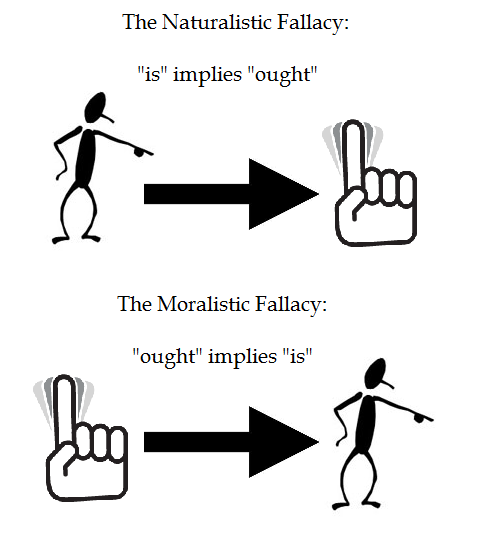
The Naturalistic fallacy is committed every single time the phrase "but it's natural!" is uttered. When someone states that something is natural--assuming they're right--they have not said anything about the value we should assign to it; they have merely made an existence claim. They are trying to make a value claim based on the implicit assumption that "natural things = good." First let's unpack what it even means to say that something is "natural."
To say something is natural is to broadly say that it has not been contaminated in some way by dirty humans. It's part of the world that exists independent of our interference. The idea of natural gets tricky though when we talk about what is natural for us to do. When people say that a behavior is natural, they seem to be implying that it is a part of our human nature. This can be contrasted with normal, indicates an importance placed on the norms of rules of the society one lives in.
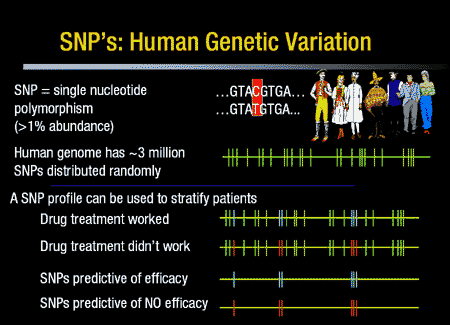
Understanding what is natural for humans is equivalent to understanding human nature. The ties that bind us into the category of humans means that we are far more similar than different. The actual difference in our genomes from person to person is 0.1%. This minute amount accounts for what we actually perceive as gigantic differences. Because we're sensitive to differences and the similarities are just things we take for granted. No one walks around going, "Oh my god, you also use language, sleep, eat food, and have a sex drive?!"
So the "age old question" of nature vs. nurture is not as mysterious as many may think. The goal of most psychological research is to find something that is similar in all of us, and for this to work, it requires the hypothesis that there is a shared human nature. If our individual differences were so extreme that nothing could ever be accurately predicted about human behavior, then psychology as a science would not exist. Through extensive research, we can determine facts about our human nature, but not all of these facts align with how we would like things to be.
Obesity is a historically recent trend. If you asked most people why this epidemic exists, their response will probably reference that people like to eat a lot, and that some people may be predisposed to having larger body types. This isn't incorrect, but it doesn't completely answer the question. We all like to eat, but why do these people eat so much? Evolutionary psychology has a satisfying answer. In our ancestral past, food was scarce so it made the most sense to eat as much of it as you could whenever possible. The taste that we developed for certain foods was based on their survival value to us. Fruits were appealing because the sugar increased glucose levels that aided in cognitive functioning. Thus, people who ate lots of fruit reproduced more leading to a higher propensity for a sweet tooth in the gene pool. Today, we can create foods that take advantage of this "sweet tooth," leading to such creations that never existed in our ancestral past. Yet even though these foods didn't exist, the cues did, and the cues are still working now, below our conscious awareness.
What this means is that if we stick to "if it is natural, it is good" then it logically follows that obesity, working on natural cues, is good. I doubt anyone would serious defend that view. They might say "The cue is natural, but the result of obesity isn't!" And I would be inclined to agree. Nature and nurture is separable in ways such as these. We have beliefs, attitudes, desires, and fears that we are predisposed to by nature (our genes), and which can be molded ever-so-slightly by nurture (societal influence). The distinction we need to make, which people often fail to do, is that there are plenty of natural things that we don't like, and plenty of natural things that we do like. Similarly, there are plenty of societal things that we don't like, and plenty of societal things that we do like. We just need to stop claiming that everything natural is automatically good because it gives a free pass to plenty of behaviors that we adaptive in our ancestral past that we can rationally say no longer aid us in the world we want to live in today.
Nothing could be less natural than birth control. It is the ultimate anti-evolution technology. If natural selection were allowed to take its course and could keep up with society (this is a thought experiment) future generations would probably possess some mechanism for subverting our birth control techniques.
The entire reason we have a sex drive is because our genes want to make more copies of themselves. That doesn't mean we have to be bound to the idea that if we want sex, we also have to have children. We don't have to in our current society. But those invoking the naturalistic fallacy would have to concede that anyone who engages in sex should want children, since that is what sex is for. The pleasure is a side effect! Individuals that enjoyed sex did it more, individuals that had more sex bore more children, individuals that had children are the only sets of genes that could have survived to the next generation. Cue 4 million years of hominid evolution working with this principle and you have our current sex-obsessed homo sapiens. It is completely natural to desire sex, even lots of sex, but that can't say anything one way or another about whether or not that's a good thing for an individual or for society. Understanding the cause of our desires is extremely important to treating the things that we want to change. If you go around telling people that their sex drive is unnatural and something that someone can control because it's been taught to them, they will not only be confused, but they will have no way of dealing with their (probably) non-existent problem. Clarification is needed. Psychology, anthropology, and biology provide the answers.
Showing posts with label beliefs. Show all posts
Thursday, October 11, 2012
Tuesday, August 7, 2012
The Long Reach of Belief
The issue with many of the beliefs that people hold is that they're not simple matters of taste. I may dislike Nickelback as a band, but the fact that certain people enjoy Nickelback is of no concern to me. Why? Because people liking Nickelback has no effect on my life or that of anyone else who may dislike them. Now we have established a criterion for when beliefs held by others should matter: if the beliefs cause people to act in ways that they otherwise would not.
For example, if a person is secretly racist we may find this deplorable, but if they never act on it, in what way could we know? The chances of someone actually being racist and never acting on it are probably impossible, since these beliefs manifest themselves in subtle ways that we are generally not aware of. But the point is that beliefs lead to actions. And if these actions can hurt, oppress, and generally cause harm to society, then there is warrant for us to care what other people believe.
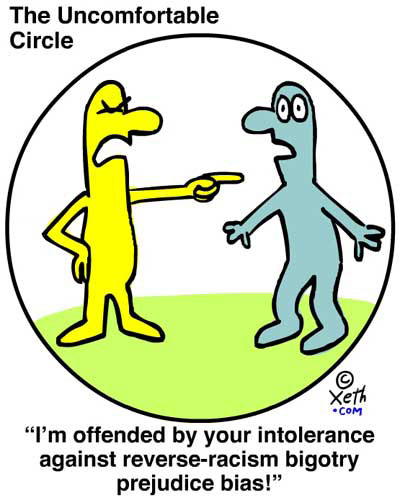
I've had people tell me that I am just as bad and intolerant of the people I am speaking out against. They've told me that just because I disagree with someone doesn't make them bad, or wrong, or give me a reason to question their beliefs. Let me illustrate a picture: does a person who is racist (something we in the liberal western world tend to think is pretty bad) have the right to say that an anti-racist is discriminating against them? That doesn't really make any sense. The people who fought to free the slaves and for civil rights aren't people we look back on and say "Geez, couldn't they just leave other people's beliefs alone?" I speak out when I think people are being oppressed or harmed.
How do we define harm? There are various ways, so I'll give some examples. When children are taught that humans walked with dinosaurs, the KKK were nice people, and gay people are as awful as rapists and child molesters, their education is harming them. When parents allow their children to die by refusing medical treatment in favor of prayer, their spiritual belief is harming them. When psychics rob people of their money by claiming they can perform spiritual healing, claim they can talk to dead loved ones, or just provide false info to further their personal gain, their credulity in charlatans is harming them. This is just a short list. I could write about a hundred more ways in which people are harmed every day due to the nature of their beliefs.
I can imagine someone saying at this point, "Okay, so some people believe some stupid things. But my beliefs don't harm anyone. For example, I don't believe in evolution and it doesn't hurt anyone."
I will attempt to illustrate that the effects of holding a view such as creationism aren't immediately obvious, but just because they aren't immediately obvious doesn't mean there can't be latent harm. For example, if there were only one person who didn't believe in evolution we wouldn't have a problem, but the fact remains that half of Americans reject evolutionary theory. And furthermore, any argument that goes, "Well, me alone doing this action isn't hurting anyone, therefore it is fine," is not justifiable when we imagine the consequences, were everyone to do it. This known as the tragedy of the commons. Therefore, yes, if you and just you alone decide to litter, you won't destroy the world, but if everyone does? Well, we're still trying to fix that mistake.
An anticipated objection at this point is "I understand that littering is bad, but you haven't demonstrated that not believing in evolution is bad."
Allow me to do so.
Sometimes the harm of a belief is that it manages to oppress a group for no other reason than to oppress them. For example, to argue that racists are oppressed by civil rights would be quite silly. The oppressors do not get to say they are being oppressed when people speak out against them. Otherwise we would have an infinite regress of each person claiming that their rights were violated when another person disagreed with them. The buck has to stop somewhere, and it stops at the opposition. You don't get to simply oppose those who disagree with you ad infinitum; you defend your original position. So when people have beliefs such as an idea that a particular race is inferior their own, they might do something like enslave that race. Even after slavery has ended, the dominant group might continue to oppress that race. We clearly understand the link here between belief and action, and while it isn't one person who keeps the wheels of oppression turning, the mindset that "Racism is okay, even if I'm not a racist" does nothing to help those who are oppressed - it does just the opposite.
So here's how the argument breaks down: sometimes the effect of a belief is apparent, as in:
Racist beliefs --> Racist behaviorSometimes it's way more latent, as in:
Science denial --> Kids dying from parent's belief in spiritual healing and lack of belief in modern medicineSometimes the path has many stops, as in:
Evolution denier --> Uninterested in science --> Not enough employment science/technology related fields --> No cure for cancer yetSometimes it's a small part of a larger problem, as in:
No issue with racist beliefs --> A system that continues to run based on oppressionIn short, beliefs matter a lot. They have an effect we are unable to see most of the time. We should not write them off as necessarily harmless for that reason alone. I consider myself a feminist, yet for so long I spent time participating in behavior quite clearly anti-feminist and lo and behold, I was completely unaware of it. It wasn't until my consciousness was raised by the efforts of other individuals that I was able to implement change.
Don't be afraid to question things. It's the only way we can get true social change.
Subscribe to:
Comments (Atom)